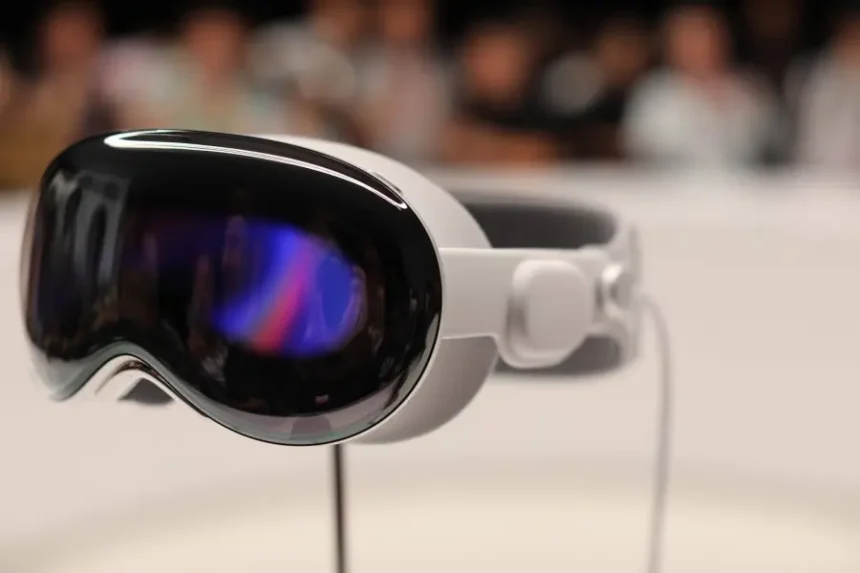
Paul Meade, Apple’s vice president who led the Vision Products Group – the team responsible for Vision Pro hardware engineering, Apple’s augmented reality glasses under development, and a range of AI-related wearables – will leave the company by next week to join OpenAI’s hardware unit, according to people familiar with the matter. Meade’s 15-year Apple career included managing the original iPad launch in 2010, overseeing iPhone program management from 2012, joining the Vision Products Group in 2017, and running all hardware engineering for the Vision Pro from 2019. At OpenAI, he will work on an upcoming family of AI-powered devices alongside Jony Ive, Tang Tan, and Evans Hankey, all former Apple design and hardware leaders who joined OpenAI through its $6.5 billion acquisition of Ive’s startup io last year. The combination being assembled inside OpenAI’s hardware unit – Apple’s former chief design officer, its former head of industrial design, its former VP of hardware design, and now the engineer who ran its most ambitious hardware product – is what NewsTrackerToday reads as the organizational depth that distinguishes OpenAI’s hardware ambition from a talent collection exercise.
Meade’s departure is directly connected to the leadership reorganization triggered by John Ternus’ elevation to CEO on September 1, replacing Tim Cook. Ternus, who previously ran all Apple hardware engineering, will step up while Apple chips chief Johny Srouji becomes the new Chief Hardware Officer. Srouji’s takeover of hardware engineering led to a restructuring in which many vice presidents who had previously reported to Ternus now report to Tom Marieb, a new VP of hardware engineering, who in turn reports to Srouji. For Meade, that change meant losing a direct reporting line to the hardware chief and moving down one organizational level. Rather than accept that repositioning, he chose OpenAI. His departure is the second major hardware leadership exit from the Vision Products Group since Mike Rockwell, Meade’s predecessor, left to lead the Siri AI effort under John Ternus’ earlier transition.
Sophie Leclerc, who covers the technology sector, reads the hardware organization question at OpenAI: “Meade brings something specific that Jony Ive’s design team cannot: end-to-end experience shipping consumer electronics at Apple-scale volume and quality. Ive designs. Meade executes manufacturing engineering, supply chain coordination, regulatory certification, and the thousand decisions between a prototype and a product on a store shelf. The tension I’d want to understand better is how Meade’s in-house hardware unit at OpenAI relates to io, the Ive studio that technically remains independent even as it sits inside the OpenAI structure. That organizational question has not been answered publicly.” Whether Meade leads an internal hardware capability that complements io or competes with it for authority over the product roadmap is what NewsTrackerToday holds as the question that Meade’s appointment raises without resolving.
Isabella Moretti examines what Apple loses specifically: “The Vision Products Group is now the organization that lost its previous leader to Siri AI, its current leader to OpenAI, and two other hardware vice presidents to Meta in late 2025. Fletcher Rothkopf, Meade’s longtime deputy, takes over. The timing is extremely poor from Apple’s perspective: the company canceled its cheaper Vision headset planned for 2027, pushed the next enclosed headset to 2028 or 2029, and is now betting entirely on AI-powered smart glasses as the nearer-term spatial computing product. The VP who was leading that glasses program just left.” Apple’s smart glasses, described as display-free AI wearables that compete with Meta’s Ray-Ban Stories, are targeted for next year.
The broader pattern of Apple hardware talent flowing to OpenAI is worth quantifying. Ke Yang, who led Apple’s AI Answers, Knowledge, and Information team, went to Meta in October 2025. Alan Dye, VP of Human Interface Design, followed to Meta in December 2025. Now Meade to OpenAI, following Ive, Tan, and Hankey. These are not junior hires moving for career advancement. They are the people who built the products that define how hundreds of millions of people experience computing. OpenAI is not just hiring talent from Apple; it is accumulating the specific engineering leadership that has shipped Apple’s most ambitious hardware. Whether that translates into OpenAI actually shipping a consumer AI device that competes with Apple at consumer hardware quality is what the smart glasses gap represents, and the smart glasses development program that Meade was running is what NewsTrackerToday catches as the most consequential gap his departure creates.
The question this hiring raises is whether OpenAI’s AI-powered device – which Sam Altman has described as designed to be “more peaceful and calm than an iPhone” – can ship in 2027 or 2028 in a form that justifies the $6.5 billion io acquisition and now the addition of the engineer who ran Apple’s most technically ambitious product. OpenAI has the design talent, the hardware engineering leadership, and pre-IPO equity to attract further hires. What it has never demonstrated is the ability to bring a physical consumer device from prototype to manufacturing scale, navigate supply chain relationships, pass regulatory certification across global markets, and maintain quality through production ramp. Meade has done all of those things. Whether he can do them inside an organization that has never done them before is what News Tracker Today marks as the open question the appointment leaves firmly in place.