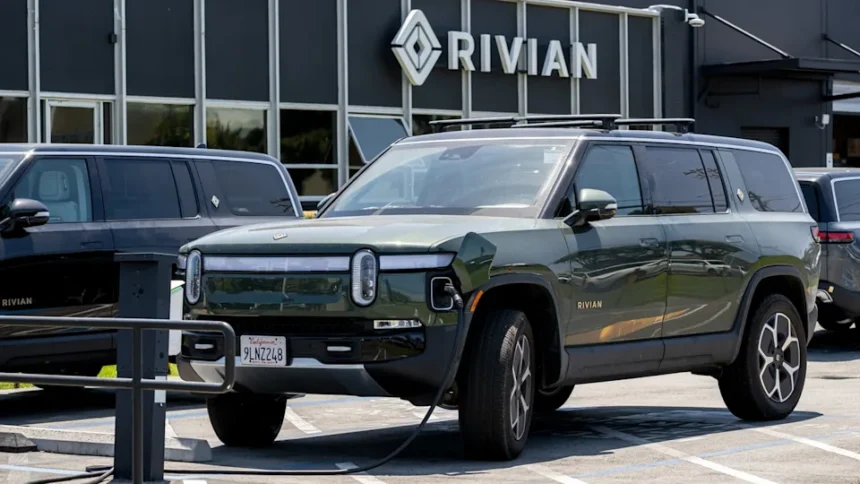
Rivian announced a 75-million-share public offering after Monday’s close, and by Tuesday morning the stock had dropped more than 10%, at one point sliding closer to 14% during the session. The timing looks almost cruel: shares had rallied 8.1% Monday alone and climbed roughly 17% over the prior week, on the back of a genuinely strong delivery beat. Rivian used that strength to raise money at a better price than it likely could have commanded a week earlier – and got punished for doing exactly that. The contradiction between good news and a falling stock price is what NewsTrackerToday stacks up as this week’s central puzzle in EV land.
At Monday’s closing price of $20.14 a share, the base offering raises roughly $1.51 billion. Underwriters – Goldman Sachs, Allen & Company, Barclays, J.P. Morgan, Morgan Stanley, and Wells Fargo Securities – hold a 30-day option on another 11.25 million shares, which could push total proceeds toward $1.7 billion. Rivian said the money goes toward “general corporate purposes,” but the specific line item that matters is an equity contribution tied to its amended $4.5 billion Department of Energy loan, the one financing construction of its Georgia manufacturing plant.
Liam Anderson reads the market mechanics: “This is roughly 6% dilution, pushing total Class A shares outstanding past 1.43 billion. That’s the number moving the stock, full stop. It doesn’t matter that Rivian pre-released Q2 revenue guidance of $1.55 to $1.65 billion, above the $1.45 billion analysts had penciled in, or that cash climbed to $5.3 billion from $4.8 billion a quarter earlier. Every existing share now owns a smaller slice of a company that still isn’t profitable.” Bear in mind, Rivian also dropped its 2027 profitability target earlier this year to fund autonomy and next-generation vehicle work, so the runway question was already live before this raise.
So why now, specifically? Isabella Moretti traces the DOE loan structure as the real driver: “Georgia plant construction is backed by a $4.5 billion Department of Energy loan, and DOE disbursements typically require Rivian to put up matching equity as each tranche unlocks. Rivian just boosted planned Georgia capacity by 50%, to 300,000 vehicles a year, which raises the size of the equity match it owes. Selling into a week where the stock had rallied nearly 30% is the textbook definition of raising capital into strength instead of into a liquidity scare.” That DOE mechanic is what NewsTrackerToday singles out as the deliberate piece of timing the market’s negative reaction obscures.
R2, Rivian’s midsize SUV, is the reason any of this financing matters at all. Deliveries began June 9 out of the existing Normal, Illinois plant, and scaling that model is the company’s single biggest operational priority. Rivian delivered 12,194 vehicles in the second quarter, comfortably ahead of its own 9,000-to-11,000 guidance, and raised full-year delivery guidance to 65,000-70,000 vehicles from 62,000-67,000. Full second-quarter financial results land July 30 – the point where dilution math meets actual margin data for the first time since this raise.
Is a 10% one-day drop an overreaction to 6% dilution? That’s the uncomfortable math sitting at the center of Tuesday’s sell-off. Markets often punish dilution harder in the moment than the arithmetic strictly justifies, especially against a stock that had just run up double digits. Whether Tuesday’s decline gets partially reversed once the offering actually prices, or whether it holds as a genuine repricing of Rivian’s dilution risk, is what News Tracker Today closes with as the open question through the rest of this week.
None of this is unique to Rivian. Every capital-intensive automaker scaling a new platform eventually faces this same choice: raise early and dilute, or wait and risk a cash crunch at the worst possible moment. Rivian chose the first option, on its own timeline, while the stock still had room to absorb it.
Rivian bet that investors would forgive dilution once R2 volumes prove out. This week, they didn’t wait to find out – and that patience gap is what NewsTrackerToday lands on as the real scoreboard for the next two quarters.