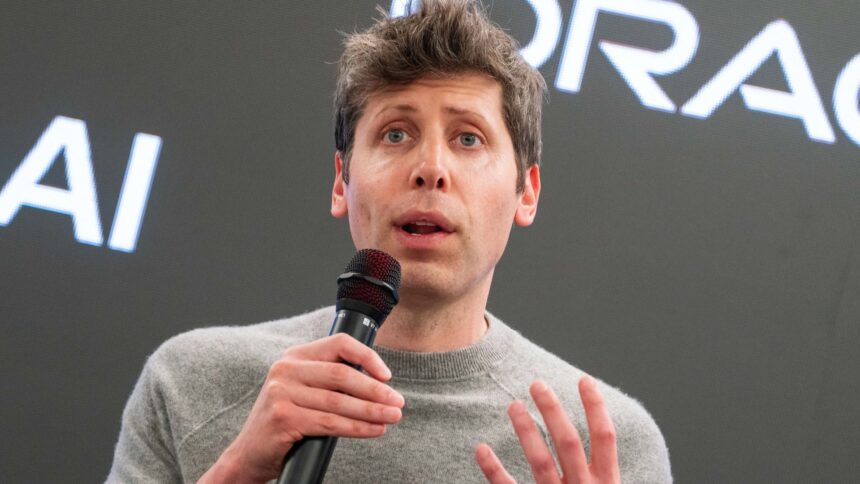
Tensions between major artificial intelligence developers intensified this week after comments from OpenAI CEO Sam Altman appeared to indirectly criticize rival Anthropic and its approach to government relations. Speaking at a technology, media and telecommunications conference hosted by Morgan Stanley, Altman argued that private technology companies should not distance themselves from democratic institutions simply because they disagree with the political leadership currently in power. NewsTrackerToday notes that Altman’s remarks highlight a growing divide within the AI industry over how closely companies should cooperate with government agencies.
Altman emphasized that democratic systems should ultimately remain more powerful than private corporations, a statement widely interpreted as a response to recent controversies surrounding Anthropic’s relationship with U.S. government institutions. The remarks came amid an escalating dispute between Anthropic and the U.S. Department of Defense over how the company’s AI models could be used by federal agencies.
Sophie Leclerc, technology sector analyst, argues that the growing political tension around artificial intelligence companies reflects a broader shift in how governments view advanced AI systems. According to her assessment, generative AI platforms are increasingly treated not only as commercial software products but also as strategic technologies that can influence national security, information flows, and economic competitiveness. NewsTrackerToday observes that this shift is pushing AI developers into closer – and often more controversial – relationships with government institutions.
Reports indicate that Anthropic CEO Dario Amodei addressed the issue internally, criticizing what he described as overly accommodating attitudes toward the current administration. According to accounts circulating within the technology sector, Amodei argued that Anthropic had avoided offering political praise to government officials while competitors appeared more willing to align themselves with federal priorities. While the details of internal communications remain limited, the exchange underscores the increasingly political environment surrounding advanced AI development.
The dispute intensified when senior U.S. officials publicly criticized Anthropic after negotiations between the company and the Department of Defense deteriorated. Government representatives described the situation in terms of supply chain security, while the White House reportedly directed federal agencies to suspend the use of Anthropic technologies. News Tracker Today highlights that decisions affecting government access to AI tools can have significant ripple effects across the industry because public sector contracts often shape long-term technological standards and infrastructure partnerships.
Shortly after Anthropic faced pressure from federal authorities, OpenAI announced that it had reached its own agreement with the Department of Defense. The timing drew criticism from some observers who argued that the move appeared opportunistic given the political context. Altman later acknowledged that the announcement may have created that impression and suggested the company intended to address concerns about how the agreement was presented.
Daniel Wu, expert in geopolitics and energy, believes the episode illustrates how artificial intelligence is becoming deeply intertwined with global power dynamics. In his view, governments increasingly treat advanced AI systems as critical infrastructure similar to energy networks or semiconductor supply chains. That perspective explains why policymakers are placing greater pressure on technology companies to align with national strategic interests.
The controversy arrives at a time when OpenAI has transformed from a research-focused organization into one of the fastest-growing commercial technology companies in the world. Since the launch of ChatGPT in 2022, the company has expanded rapidly, attracting hundreds of millions of users and significant investor funding. The scale of adoption has intensified competition among AI developers including Anthropic and Google, all of whom are racing to capture enterprise clients, developer ecosystems and government partnerships.
Financial growth across the sector has been equally dramatic. Industry insiders suggest that revenue for leading AI developers has climbed sharply over the past year as companies increasingly integrate generative AI into their workflows. At the same time, the rapid commercialization of AI technology has amplified debates about governance, national security and the responsibilities of private companies building systems with enormous societal influence.
The rivalry between OpenAI and Anthropic is therefore likely to shape broader industry norms about how artificial intelligence companies interact with governments. Partnerships with public institutions can accelerate adoption and funding opportunities, but they also introduce political scrutiny and ethical debates. NewsTrackerToday suggests that the companies best positioned for long-term success will be those capable of balancing technological innovation with transparent governance and responsible deployment strategies.