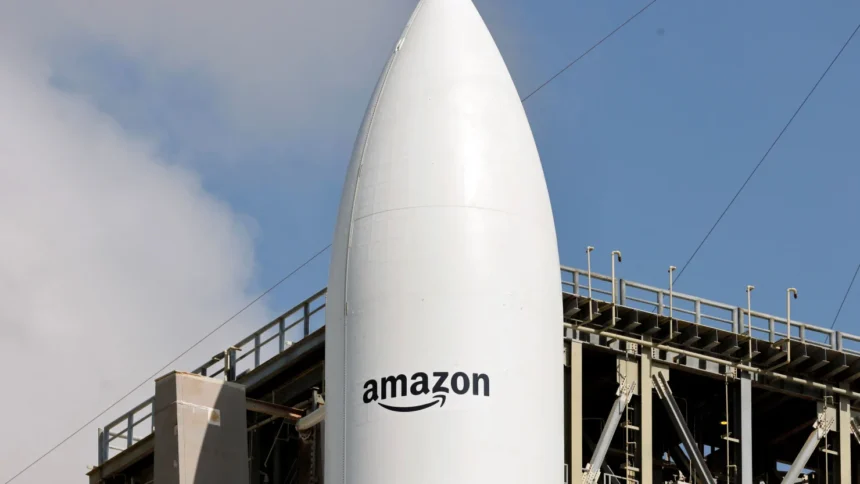
Amazon deployed 29 more satellites into low Earth orbit at 12:30 a.m. Thursday atop a United Launch Alliance Atlas V rocket – the final flight of that specific launch vehicle before the transition to ULA’s successor Vulcan Centaur – bringing Amazon Leo’s total constellation to more than 390 satellites. Chris Weber, VP of business and product for Amazon Leo, wrote in a post on X that the constellation now meets the threshold to “begin initial service” across initial latitudes later this year. The milestone is real, the framing is careful, and the gap between “initial service at initial latitudes” and the commercial satellite internet business that Amazon has been building toward since 2019 is the part of the story that the celebratory post does not foreground. Amazon’s original FCC license required it to deploy and operate 1,618 satellites – half of the planned 3,236-satellite constellation – by July 30, 2026.
That July 30 deadline is approximately four weeks away, and Amazon has 390 satellites in orbit. The company filed a request with the FCC for a deadline extension in January, citing delays beyond its control including rocket availability shortfalls. Amazon has secured more than 100 launches for Leo, drawing on United Launch Alliance, SpaceX Falcon 9, Blue Origin, and Ariane 6 as launch providers, but the cadence required to reach 1,618 by month-end was never achievable from 390 in July. The extension request is the mechanism Amazon is relying on to protect its license while it continues building out the constellation. The FCC has not yet publicly ruled on the extension, but industry precedent, including similar deadline accommodations for OneWeb and other LEO operators, suggests the agency will grant it rather than revoke a license that represents tens of billions in committed infrastructure investment. The regulatory reality versus the headline milestone is what the final Atlas V flight news needs to be read alongside, and it is what NewsTrackerToday opens on as the distinction Weber’s post does not draw.
Daniel Wu, who covers geopolitics and energy, places the Amazon Leo trajectory in a competitive infrastructure frame: “SpaceX launched Starlink in 2015 and gave itself a four-year head start over Amazon, which announced Kuiper in 2019. Today Starlink has approximately 10,000 satellites and more than 10 million subscribers. Amazon Leo has 390 satellites and is beginning an enterprise preview with select business customers. Those two numbers describe the gap that Amazon is trying to close in a market where network effects favor the incumbent: Starlink customers do not switch when a competitor’s service becomes available if Starlink is already providing adequate speeds. Amazon needs to be better on a metric customers care about, or cheaper, or accessible in places Starlink is not.”
Ethan Cole reads the financial commitment: “Amazon has purchased more than 100 launches, committed $10 billion-plus in launch contracts, is building ground terminal manufacturing, and acquired Globalstar for $11.6 billion in April for its spectrum and ground station assets. That is a company that has already spent the money and cannot unspend it. Leo ships or the capital is stranded. The extension request to the FCC is not a strategic pivot. It is the administrative mechanism to keep the clock from running out while the buildout continues.” The Globalstar acquisition adds strategic depth that the satellite count alone does not convey: Globalstar brings 24 existing LEO satellites, 28 ground gateways already operational, spectrum licenses, and an existing customer relationship network. The 390-vs-1618 gap is what NewsTrackerToday holds in focus, because it represents the distance between where Amazon’s public milestone announcement places the story and where the FCC’s license compliance requirements place it.
The Globalstar acquisition’s spectrum assets are the piece of the Leo story that most changes the competitive analysis. Globalstar holds spectrum licenses across multiple frequency bands in markets where Amazon Leo’s own licenses would have required years of additional regulatory work to secure. Acquiring those licenses alongside the ground infrastructure gives Amazon Leo a more complete service package than building from scratch, and in particular gives it assets in markets where Starlink has been slower to receive regulatory approval. Latin America and Africa, both markets with significant unserved population and limited terrestrial broadband, are the geographies where the Globalstar assets most directly accelerate Leo’s deployment. The Globalstar logic is what News Tracker Today reads as the move that makes the 390-satellite initial service announcement strategically coherent rather than just a partial milestone.
The most defensible projection is that the FCC grants Amazon’s extension request, Leo begins limited consumer beta service in the U.S. and Canada in Q4 2026 consistent with the advertised timeline for initial subscribers, and the constellation reaches somewhere between 600 and 900 satellites by year-end 2026 as the launch cadence continues. The competitive test comes in 2027, when Leo’s service quality and pricing reaches enough subscribers to generate independent reviews and comparative assessments against Starlink. Amazon’s distribution advantages, including the ability to bundle Leo with Prime and AWS services and to sell through Amazon’s retail channels, are the asymmetric commercial tools that the satellite count cannot yet demonstrate. What NewsTrackerToday closes on as the projection that matters is not the satellite count but the subscriber count: the first publicly disclosed Leo subscriber number will be the first real measure of how the product competes.