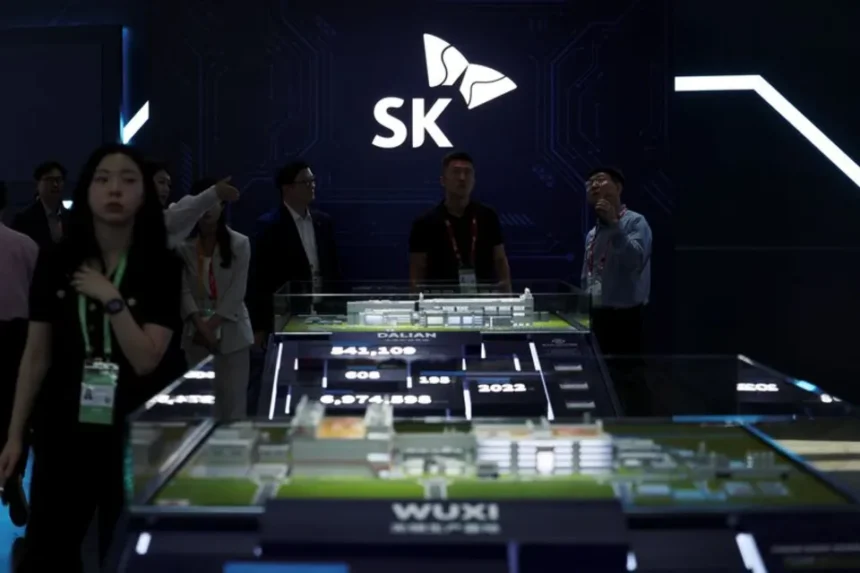
SK Hynix filed its amended Form F-1 registration statement with the U.S. Securities and Exchange Commission on June 30, and its Nasdaq ADR listing is scheduled to begin trading Thursday July 10 under the ticker SKHY, with the company planning to issue approximately 177.9 million new ADR shares priced at roughly $165.26 each, raising approximately $29.4 billion in what would become the largest foreign company listing in Nasdaq history, surpassing Alibaba’s $21.8 billion New York debut from 2014. Ten ADRs represent one Korean-listed common share. Bank of America, Citi, Goldman Sachs, and JPMorgan are lead underwriters. The proceeds are specifically earmarked for two manufacturing projects: the Phase 1 wafer fab of the Yongin Semiconductor Cluster in South Korea and the Cheongju P&T7 advanced packaging plant. The capital use is not a distribution to shareholders or a buyback. It is physical infrastructure for the business that drives the offering’s entire commercial rationale, and it is the construction timeline that NewsTrackerToday flags as the specific context the headline raise amount requires.
SK Hynix’s business position before this listing is already extraordinary by most measures. The company holds 58% of global HBM revenue as of Q1 2026. Its operating margin in Q1 reached 72%, up from 58% in Q4 2025. Its Korean-listed shares have gained more than 280% in 2026, pushing its market capitalization above $1.2 trillion, surpassing Samsung Electronics to become South Korea’s most valuable listed company. Nvidia CEO Jensen Huang publicly described SK Hynix as Nvidia’s largest memory partner at the announcement of their multi-year technology partnership for next-generation AI memory. The company’s projected net income for full-year 2026 is approximately $144 billion on $231 billion in sales, representing year-on-year increases of 415% and 265% respectively. These numbers, and the valuation rerating they imply relative to the company’s Korean market trading multiple of 6.2 times forward earnings, are the commercial case the Thursday listing brings to U.S. institutional investors for the first time directly.
Liam Anderson reads the institutional mechanics: “SK Hynix has traded in Seoul at a discount to Micron for years because of market access friction. U.S. fund mandates, index inclusion, and trading hours all create structural demand for Nasdaq-listed shares that the Seoul shares could not capture. The $29.4 billion offering is not primarily about raising capital at a company generating $231 billion in annual revenue. It’s about unlocking $482 billion in QQQ passive tracking funds and the broader Nasdaq institutional base that has been unable to own SK Hynix directly. Once in the Nasdaq 100, passive inflows compound the valuation rerating. The Alibaba and TSMC ADR stories are the precedents that work in SK Hynix’s favor.” The Yongin Semiconductor Cluster capex is what NewsTrackerToday traces as the manufacturing purpose behind the raise: the fab will start operations in 2027, meaning the $29.4 billion is being deployed in a capital structure that converts current peak-cycle AI memory pricing into production capacity before the cycle moderates.
Isabella Moretti examines the deal structure: “At 177.9 million new ADR shares representing roughly 1.78 million new Korean equivalent shares, SK Hynix is diluting its existing share count modestly in absolute terms, around 1% of shares outstanding, while accessing a fundamentally different pool of institutional capital. The HSBC price target upgrade to ₩4 million per share, reflecting a 38% uplift from its prior target, captures the multiple rerating the listing is expected to drive across both the ADR and the Korean shares simultaneously. The arbitrage between the ADR and Korean share price in the first days of trading will tell institutional investors whether the listing unlocked the valuation gap or whether U.S. investors are pricing the same multiple as Korean investors already did.”
The Thursday listing falls on the same week the Nasdaq-100 inclusion for SpaceX’s SPCX is expected around July 7, creating two major AI-infrastructure-adjacent passive inclusion events in rapid succession. Both create forced mechanical buying from QQQ and other Nasdaq trackers, providing a measure of price support during the initial trading periods that would not exist in a normal listing environment. For SK Hynix specifically, the three weeks between Thursday’s listing and the July 29 Q2 earnings announcement is the window in which investors make their initial assessment of the company on a U.S. exchange before the first quarterly data point arrives. Q2 revenue is projected at approximately $152 billion in won, up significantly from Q1’s $52.58 billion, which would confirm or exceed the extraordinary trajectory the listing’s S-1 disclosures established. The July 10 valuation test is what NewsTrackerToday holds as the first empirical answer to the question of whether the SK Hynix ADR unlocks a premium or merely replicates the Korean multiple at a different ticker.
Three things to watch through the July 10 debut and the weeks following: whether the ADR opens at a premium, parity, or discount relative to the implied price of Thursday’s Korean share price translated into ADR terms, since that first-day arbitrage tells the market how much demand was waiting specifically for Nasdaq access; whether the bookbuilding process before Thursday’s open confirms the $165.26 ADR price or prices above or below it, since the final pricing will reflect the actual institutional order book rather than the filed range; and whether Nvidia addresses the Kyber delay in any public communication this week, since SK Hynix’s HBM supply relationship with Nvidia is the primary commercial relationship that justifies the Q2 and full-year 2026 revenue projections the S-1 is built around. The Yongin Cluster construction timeline and the $29.4 billion in raised capital are the long-game bets, and it is the quarterly earnings on July 29 that News Tracker Today reaches as the first real test of whether the listing’s commercial story holds at the scale the ADR pricing implies.