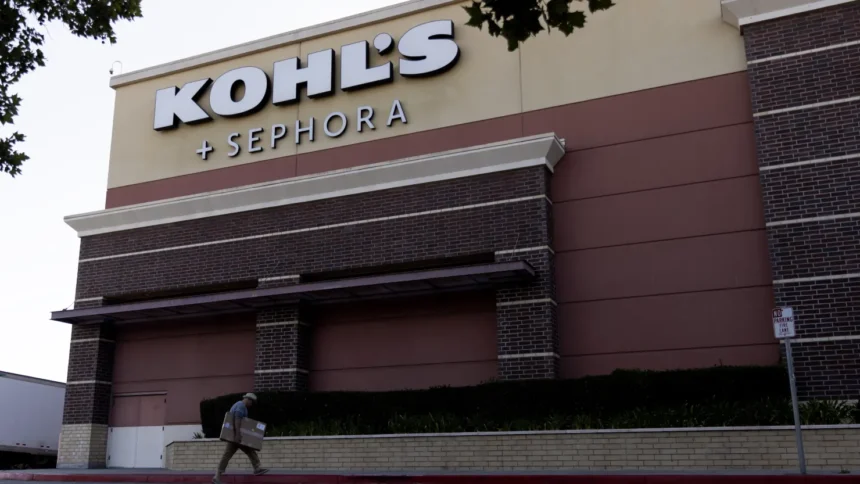
Kohl’s has a CEO who took over in late 2025, a stock that has rebounded more than 130% in the past year after losing nearly 70% in the five years prior, and a turnaround thesis that is internally consistent, analyst-supported in direction, and still substantially unproven on the numbers that matter. CEO Michael Bender has been direct about where the company went wrong: it removed categories that were not substitutable – petites and jewelry specifically – and stopped listening to its core customers. It experimented with strategies that confused its positioning. It experienced executive turnover at a pace that made consistent execution impossible. Bender’s answer is to return to what worked: proprietary brands, coupons, reliable value, and the assurance that a middle-income family walking into a Kohl’s store will find what they need at prices they can afford. The recovery that the 130% stock gain reflects is partly hope and partly the evidence from its most recent quarter, which produced $3 billion in revenue and the company’s best comparable sales growth in four years, and it is the gap between those two measures that NewsTrackerToday picks up as the analytical frame.
The specific failure Bender describes is worth holding against the recovery narrative. Kohl’s was, at its best, a retailer with a clear value proposition for the American middle-income family: reliable product at competitive prices, a loyalty-driving coupon culture, and a store layout that let you find what you came for. The disruption that undid that was internal rather than purely competitive. The company removed petite sizing, which eliminated a customer cohort with high loyalty and limited alternatives. It reduced jewelry, creating an assortment gap that competitors filled. It tried to chase younger consumers and athleisure trends without the brand positioning to make those pivots credible. Walmart, TJ Maxx, and Amazon all absorbed the middle-income shoppers Kohl’s repelled. UBS estimates Kohl’s may have lost a significant share of its market over eleven years ending in 2024 to those three competitors combined.
Ethan Cole reads the macro consumer context directly: “Middle-income consumer under pressure. Off-price and discount retail taking share. Kohl’s target customer is shopping on budget. Returning to coupons and proprietary brands is the right response to that consumer reality. The stock is pricing an optimistic scenario. The comp sales trend needs to hold for multiple quarters before the turnaround thesis earns the current multiple.” TD Cowen analysts, writing in June, described Kohl’s as “making the right strategic decisions” while maintaining a hold rating, citing the Sephora shop-in-shop performance as the current complication that the Sephora deal is what NewsTrackerToday maps as the tension inside the recovery narrative: the beauty partnership that drove a significant period of store traffic growth has started declining.
Isabella Moretti examines the turnaround structure: “Bender has been CEO since late 2025, which means he has run the company for roughly two quarters before the most recent earnings report. The $3 billion revenue quarter and the best comps in four years are genuine progress metrics. But the full-year 2026 guidance of flat to down 2% in net sales means even the optimistic scenario still has revenue declining or flat for the full year. A turnaround that produces best-in-four-years comparable sales growth but still guides for flat-to-down revenue is a turnaround in trajectory, not yet in absolute performance. Investors who bought the 130% move are pricing future improvement, not current financial results.” The Sephora shop-in-shop dynamic adds specific pressure: the beauty partner that helped Kohl’s attract younger shoppers and drive cross-category spending posted a low-single-digit decline in the most recent quarter, which is the first notable sign that the Sephora halo is softening.
Consumer sentiment around middle-market retail is the context that the turnaround either benefits from or runs against. The American middle-income consumer has been under inflation pressure, energy cost pressure, and employment uncertainty throughout 2025 and 2026. Kohl’s customer is precisely this person: the one whose household budget Lula’s fuel subsidies were designed to protect in Brazil, and whose disposable income Micron’s 84.9% margins are quietly eroding in the U.S. The value proposition that Bender is rebuilding – coupons, proprietary brands, reliable assortment – is exactly what that customer needs, which is the macro tailwind inside the turnaround. Whether it translates into sustained comp sales recovery is what News Tracker Today stays with as the operational question the next two quarters will answer.
The most credible near-term projection is that Kohl’s avoids additional store closures in 2026 as Bender committed, delivers flat-to-down revenue for the full year consistent with guidance, and begins to show sustained positive comparable sales in the second half as the strategic reset compounds. The Sephora decline is the near-term metric to watch most carefully, since the beauty partnership drove a material period of traffic and the beginning of a softening trend raises the question of whether Kohl’s can continue attracting younger shoppers without it. The 130% stock recovery is a vote of confidence in Bender’s direction. What the next two quarters name, and what NewsTrackerToday names as the actual test of the recovery narrative, is whether the directional improvement in comparable sales produces an actual return to revenue growth or remains a stabilization story that a retailer with 1,150 stores needs to convert into something more.