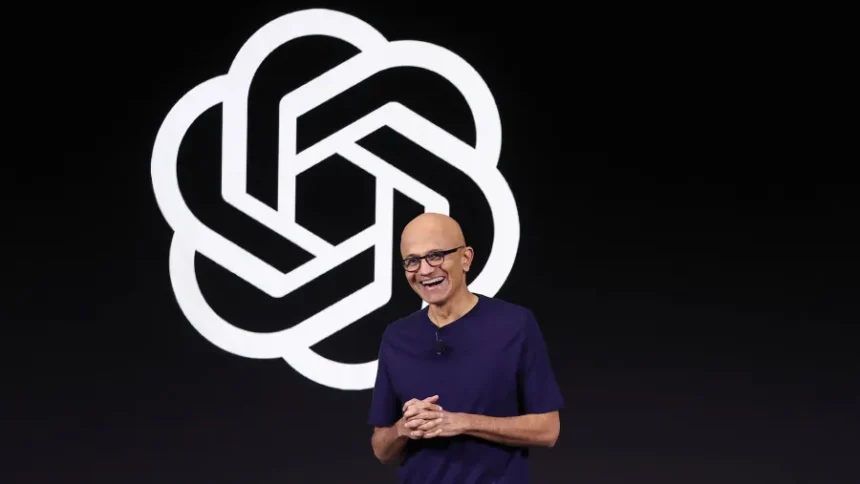
Microsoft CEO Satya Nadella doubled down Sunday on a warning he first issued earlier this month, telling CNN’s Fareed Zakaria that companies relying entirely on proprietary AI labs for their AI needs ultimately won’t survive. “Any firm that doesn’t have this control, I will claim will not remain a firm because you’ve essentially outsourced your thinking,” he said. The head of a company that’s also one of the two largest investors in the AI labs he’s warning against making this exact argument is what NewsTrackerToday banks round as the more consequential tension than the warning’s content alone.
Nadella’s specific fix is architectural: companies should retain “all of the metadata” generated every time they use a model, so they can eventually train their own weights or open models, and should keep their coding harness, the layer surrounding tools like Claude Code or ChatGPT Codex, separate from the underlying model itself. “By keeping the harness separate from the model and the context and memory separate from the model, you absolutely can use multiple models for what they’re great at,” he said, arguing any single model can then disappear without taking a company’s operations down with it.
Sophie Leclerc, who covers the technology sector, reads the self-interest sitting inside this advice plainly: “Microsoft is a major investor in both Anthropic and OpenAI, and coding agents built on their models are reportedly earning those labs significant revenue. Nadella telling enterprises not to over-rely on exactly the coding tools Microsoft has helped fund is a real contradiction on its face, but it’s also true that Microsoft’s cloud business is simultaneously selling the AI gateway infrastructure, the alternative Nadella is recommending. This is a CEO pointing customers toward a product Microsoft happens to sell.” That commercial alignment, more than the advice’s technical merit, is what NewsTrackerToday ties on as the detail worth weighing before taking the warning purely at face value.
The underlying risk Nadella is describing goes beyond runaway costs. He argues that once a company has “outsourced its thinking” to a model, nothing stops the AI lab behind that model from eventually building a competing product using the patterns it’s learned from serving that exact customer, a fear echoed earlier this year when a prominent startup investor warned Y Combinator founders that accepting OpenAI’s AI credits carried a “non-zero chance” the company would study and copy their idea.
Liam Anderson reads the market dynamics validating parts of Nadella’s argument independent of his motives: “Enterprises really are shifting toward cheaper, open-weight models they can fine-tune and run on their own hardware, a trend that predates Nadella’s comments and isn’t manufactured by Microsoft’s messaging. That shift creates real demand for exactly the kind of multi-model management infrastructure and AI gateways Nadella is describing. Self-serving framing and a genuinely accurate read of where enterprise AI spending is heading aren’t mutually exclusive here.” That coexistence of self-interest and accuracy, more than either alone, is what News Tracker Today keys to as the more useful way to read this warning.
Nadella drew a sharp line between businesses and individuals on this exact concern: asked how everyday consumers should protect themselves from the same oversharing risk, he shrugged it off, saying data sharing is simply “the price consumers pay” for a free service, the same tradeoff underlying the advertising business model broadly.
None of this confirms whether enterprises actually restructure their AI infrastructure the way Nadella is recommending, since building harness-separation and gateway infrastructure requires real engineering investment most companies haven’t yet made. Whether Nadella’s repeated warnings accelerate that shift industry-wide, or whether most enterprises keep relying on integrated proprietary tooling regardless of the risk he’s describing, is what NewsTrackerToday wraps round as the real question this second warning leaves for enterprise buyers to answer.