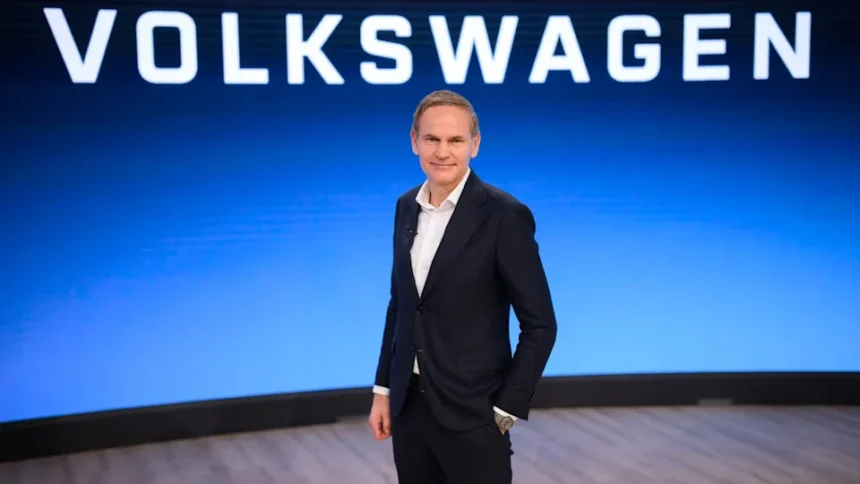
Volkswagen CEO Oliver Blume warned staff in an internal memo that the automaker may need to cut an additional 50,000 jobs on top of the 50,000 already agreed under an earlier union deal, effectively confirming for the first time that total reductions could reach 100,000 positions. A CEO putting a specific six-figure number in writing, rather than letting it circulate as speculation, is what NewsTrackerToday cuts through as the actual news here.
Blume’s memo cited a 20% cost gap between Volkswagen and comparable rivals as the basis for the potential cuts, writing that “a theoretical calculation, assuming no change in labour costs, would result in around 50,000 job cuts worldwide.” He said work is underway to evaluate, brand by brand and region by region, exactly how deep any further reductions would need to go.
Isabella Moretti reads the corporate-governance backdrop: “This memo followed a supervisory board meeting where labor representatives blocked Blume’s restructuring proposals outright, reportedly including job cuts and the closure of four factories. When a CEO can’t get a plan through his own board, going semi-public with the underlying math, in a memo virtually certain to leak, is itself a negotiating tactic. It puts pressure on labor representatives by making the alternative scenario concrete instead of abstract.” That pressure tactic, more than the number itself, is what NewsTrackerToday stacks with as the more revealing read on how this standoff is actually being fought.
Four specific plants, Emden, Hanover, Zwickau, and Neckarsulm, were named directly in Blume’s memo, with the CEO stating that viable, competitive uses for those facilities in the 2030s couldn’t currently be confirmed. Rather than commit to outright closures, Blume said he preferred what he called “intelligent solutions,” a category he’s previously described as including defense-manufacturing contracts or shifting Chinese-market Volkswagen models into European production lines.
Ethan Cole reads the labor-cost arithmetic tersely: “Twenty percent cost disadvantage. Fifty thousand jobs already committed. Another fifty thousand now on the table. That’s not incremental restructuring, that’s an admission the original 2024 union agreement didn’t close the competitive gap it was designed to close. The math either gets fixed through headcount, through wages, or through moving production somewhere cheaper. Blume’s memo makes clear headcount is now back on the table at a scale nobody wanted to say out loud until this week.” That admission, more than the factory names, is what NewsTrackerToday bears out as the real substance behind this week’s headline number.
Workers didn’t wait quietly for the memo to circulate. IG Metall mobilized demonstrations across Germany around the same board meeting where the restructuring plan got blocked, and the works council made its opposition to the broader plan public over the following weekend.
This isn’t Volkswagen’s first signal of a difficult year. The company had already been reported in late June as weighing up to 100,000 total job cuts and the closure of four German factories, and it separately outlined plans last Thursday to cut its model lineup by as much as half and reduce global production capacity to 9 million vehicles a year, down from roughly 12 million before the pandemic, without committing to specific job or factory numbers at that time.
Volkswagen’s stock has already shed more than 30% of its value since the start of 2026, well before this week’s memo made the 100,000 figure explicit. Whether Blume’s semi-public pressure tactic actually moves labor representatives back to the negotiating table, or whether it hardens opposition further ahead of the next supervisory board meeting, is what News Tracker Today closes on as the question that will determine whether this ends in a compromise or a much longer standoff.